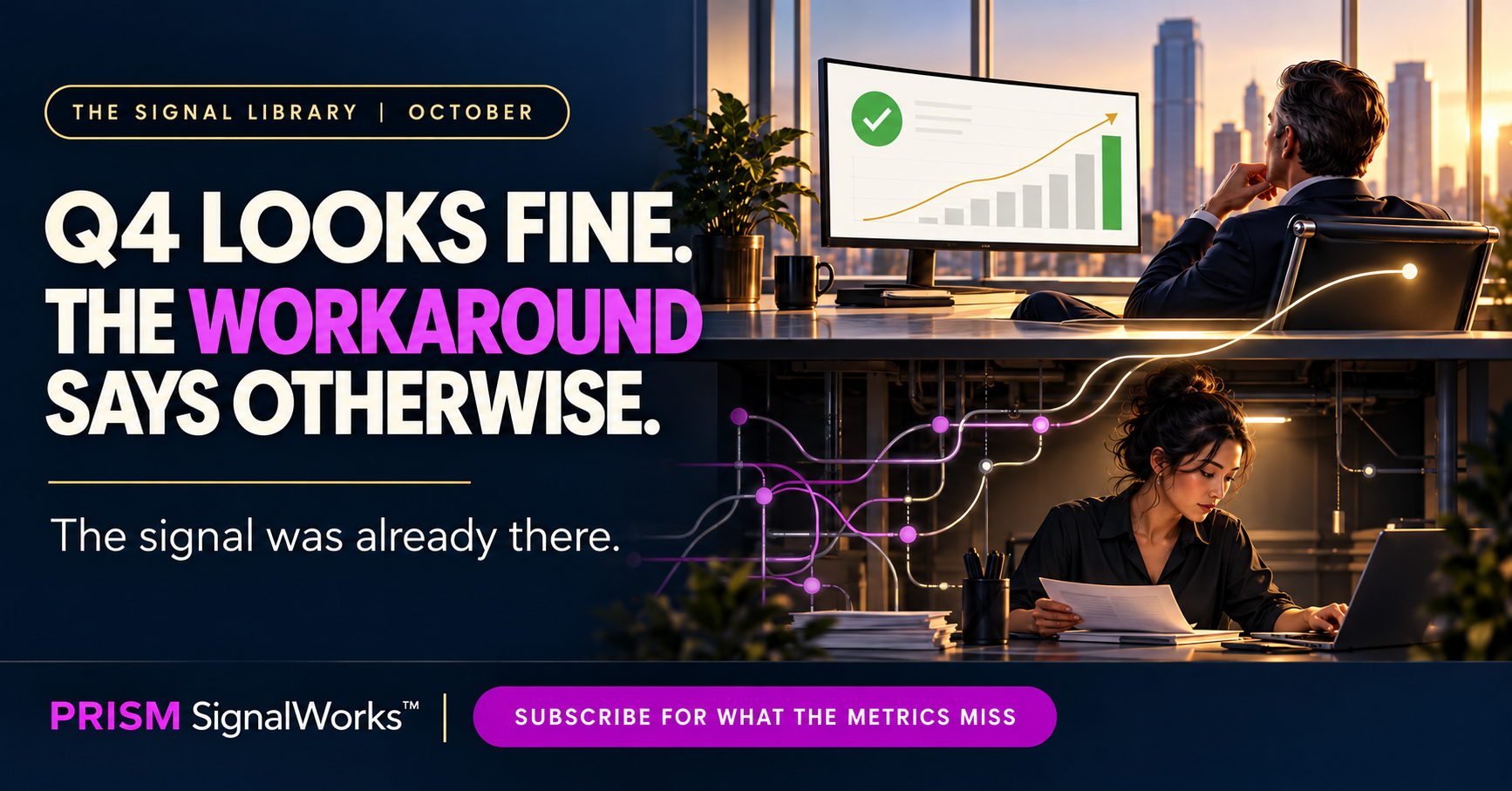
Q4 Looks Fine.The Workaround Says Otherwise.
What fourth-quarter pressure reveals about how work really gets done
Every October, organizations begin speaking a very specific language.
“We just need to get through the quarter.”
“Can someone handle this manually for now?”
“We’ll clean it up after year-end.”
And my personal favorite:
“That’s just how we do it.”
That last sentence always gets my attention.
Because somewhere between temporary fix and business as usual, the workaround became the process—and nobody officially announced it.
There was no meeting.
No rollout plan.
No training deck.
One day, everyone simply accepted that getting the work done required three spreadsheets, two side conversations and the one person who knows which number is actually correct.
The organization is still moving.
But the work is much harder than it looks.
Q4 Does Not Create the Problem
Fourth-quarter pressure does not suddenly make an organization unstable.
It reveals where the instability was already hiding.
- The customer commitment that requires three people to verify.
- The forecast that looks clean only because someone corrected it before the meeting.
- The order that cannot move until the right person sends the right message to the right person.
- The escalation everyone calls “unexpected”—except the frontline employees who watched it building for three weeks.
During a slower period, we may call this flexibility.
Or teamwork.
Or “going above and beyond.”
By October, the same behavior starts producing late nights, repeated follow-ups and a whole lot of:
“Did anyone hear back yet?”
That is the signal.
The Workaround Is Not the Villain
Workarounds are not always bad.
Most begin because someone smart recognized a problem and refused to let the customer, project or order fail.
That employee deserves credit.
The risk begins when the temporary solution becomes permanent—and the organization becomes dependent on the person performing it.
- Issue
- Workaround
- Routine
- Complacency
- Standard Practice
- Normalized Risk
Eventually, no one questions the extra steps.
New employees are quietly taught the “real” process.
Experienced employees become human search engines.
Leadership sees the final result without seeing everything it took to produce it.
The metric says the work was completed.
The metric does not say that Linda had to chase six people to complete it.
Linda knows.
The dashboard does not.
What Are Your People Quietly Fixing?
- Where are employees repeatedly chasing information?
- What must be manually corrected before leadership sees it?
- Which customer commitments depend on one experienced employee?
- What “temporary” solution has been in place for more than one quarter?
- Where does the documented process differ from the real process?
- Which problems surprise leadership but not the people closest to the work?
These questions reveal the distance between how an organization believes work happens and how work actually happens.
That gap is where risk grows.
It is also where some of the organization’s most valuable knowledge may be hiding.
What PRISM Looks For
- PPatternsWhat keeps happening?
- RRiskWhat could affect the customer, revenue or operation?
- IInstabilityWhere does success depend on extra effort or individual intervention?
- SSignalsWhat are employees, customers and workflows already telling us?
- MMovementIs the condition improving, spreading or becoming normal?
The purpose is not to create another list of problems.
Most organizations already have enough lists.
The purpose is to understand what the pattern is telling us—and determine what deserves attention first.
Before We Automate the Work, We Need to Understand It
AI can help teams work faster.
But when AI is introduced into a process built on unofficial handoffs, unwritten rules and employee memory, it may simply help the wrong process move faster.
AI cannot use context the organization never captured.
It does not automatically understand why an experienced employee checks one more system before confirming an order.
It does not know why a certain combination of events makes the frontline nervous.
And it does not understand the history hidden behind:
“That customer is different.”
First, the organization must recognize that these decisions contain valuable intelligence.
Then it must make that intelligence visible.
Do Not Waste the October Signal
Fourth-quarter pressure gives leaders a window into the organization.
It shows where processes bend.
Where information stops moving.
Where employees step in.
And where the business is being protected by effort that leadership may never see.
Before everyone promises to fix it in January, pay attention to what October is showing you now.
Capture the workaround.
Ask why it exists.
Understand the judgment behind it.
Look for the pattern underneath it.
Your biggest signal may not be that your team is struggling.
It may be that your team has become exceptionally good at making the struggle invisible.
The signal was already there.
What signal does this raise in your organization?
Share what you're seeing. Every response is read and approved by Rhonda before it appears.
Loading responses…
What has your organization learned to work around instead of actually fixing?
The dashboard gives you the metric.
I’ll help you find the signal.
Once a month, I break down one operational signal leaders may be seeing—but not yet recognizing.
Expect practical observations about hidden risk, normalized workarounds, organizational intelligence and what is really happening underneath the dashboard.
Is a Workaround Becoming Your Process?
The free PRISM Signal Scan helps you identify where work is becoming harder than it should be—and which early signals deserve a closer look.