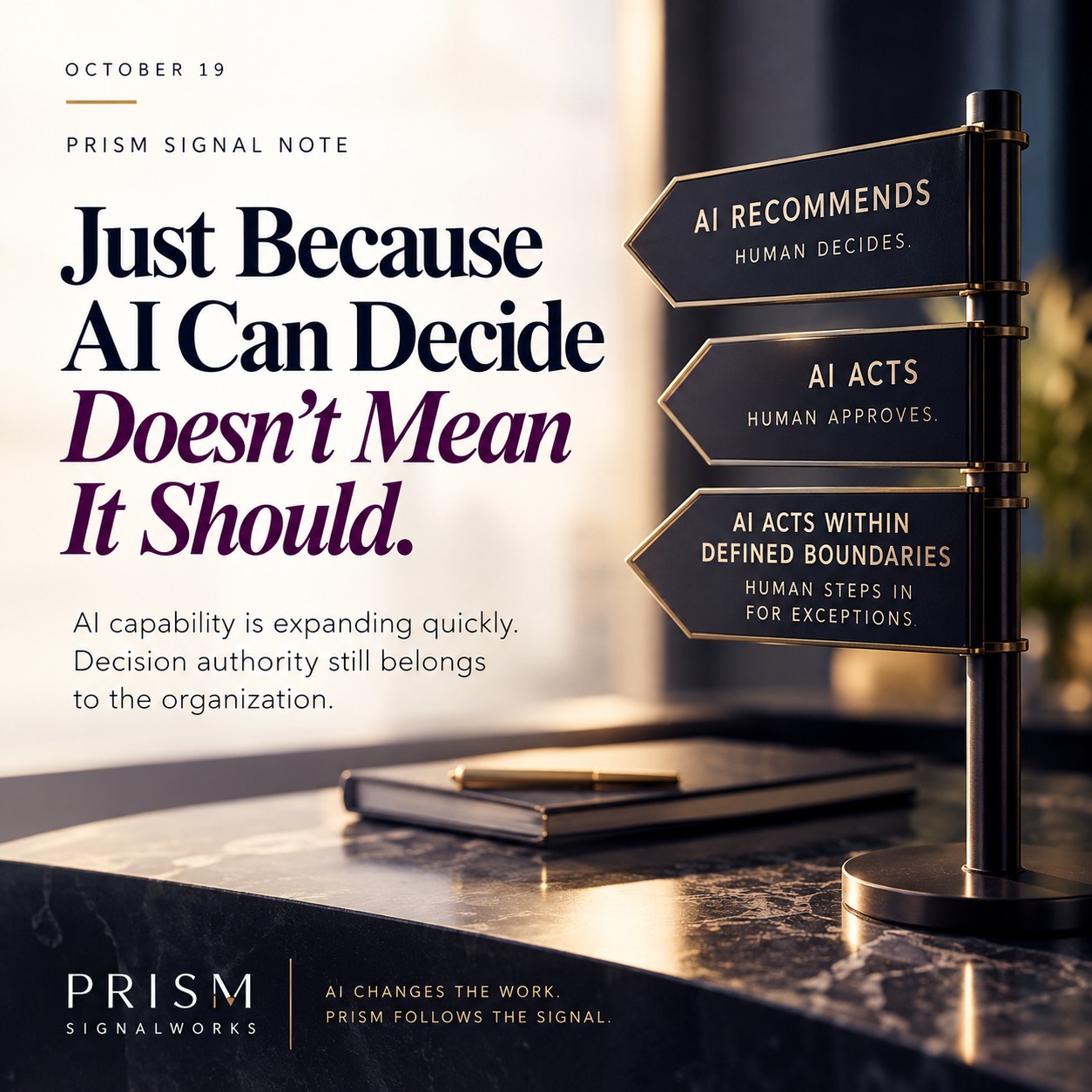
Just Because AI Can DecideDoesn't Mean It Should
AI capability is expanding quickly. Decision authority still belongs to the organization.
The Signal I See
AI is getting better at making recommendations.
Now it's increasingly capable of taking action.
That changes the question.
It isn't only:
Can AI make the decision?
It's:
Who decided AI gets to make it?
Same AI. Different Decision Rights.
Human decides.
Human approves.
Human steps in for exceptions.
The technology may be identical.
The organizational design is not.
This Is Where AI Workforce Design Begins
Before assigning work to AI, leaders need to define:
- What can AI see?
- What can it recommend?
- What can it execute?
- What requires approval?
- What happens outside the normal pattern?
- When must a human step back in?
- Who owns the outcome?
AI capability does not determine decision authority.The organization does.
- Patterns
- Repeated overrides are a signal.
- Movement
- Growing approval queues are a signal.
- Instability
- Increasing exceptions are a signal.
- Signals
- Employees repeatedly stepping back into automated workflows are a signal.
These may indicate that the decision boundary, context or workflow needs to change.
When someone proposes giving AI more autonomy, ask:
“What decision right are we actually giving it?”
If nobody can answer clearly, that may be the signal.
IBM Institute for Business Value, 2026 CFO Study, September 30, 2026.
Cited for context. The source does not endorse PRISM SignalWorks.
Autonomy should follow clarity.Not the other way around.
“What decision right are we actually giving it?”
Share what you're seeing. Every response is read and approved by Rhonda before it appears.
Loading responses…
You don't need to know exactly what's wrong to start looking.
Find My SignalFree · 5 questions · About 2 minutes · No sales call